A ____ Input Is the Statement That Reads the First Input Value in a Program.
2. Values, expressions, and statements
two.one. Programs and data
We tin can restate our previous definition of a computer program colloquially:
A computer program is a step-by-step fix of instructions to tell a computer to do things to stuff.
Nosotros will be spending the residual of this book deepening and refining our understanding of exactly what kinds of things a estimator can do. Your ability to programme a computer effectively will depend in large part on your ability to understand these things well, and then that you can express what yous want to attain in a language the figurer can execute.
Before we become to that, withal, nosotros demand to talk well-nigh the stuff on which computers operate.
Computer programs operate on data. A single piece of data tin can be called a datum, but nosotros volition use the related term, value.
A value is 1 of the central things — similar a letter or a number — that a programme manipulates. The values we accept seen then far are 4 (the result when we added 2 + 2 ), and "Hi, Earth!" .
Values are grouped into different data types or classes.
Note
At the level of the hardware of the motorcar, all values are stored as a sequence of bits, usually represented by the digits 0 and 1 . All computer data types, whether they exist numbers, text, images, sounds, or anything else, ultimately reduce to an interpretation of these flake patterns past the computer.
Thankfully, high-level languages like Python give the states flexible, high-level data types which abstract away the tedious details of all these bits and meliorate fit our man brains.
4 is an integer, and "Hi, Earth!" is a string, so-chosen because it contains a cord of letters. You lot (and the interpreter) tin can identify strings because they are enclosed in quotation marks.
If you are not sure what course a value falls into, Python has a function called blazon which tin can tell you.
>>> type ( "Hello, World!" ) <class 'str'> >>> type ( 17 ) <class 'int'> Not surprisingly, strings vest to the class str and integers belong to the grade int. Less manifestly, numbers with a bespeak between their whole number and partial parts belong to a course chosen float, because these numbers are represented in a format called floating-point. At this stage, yous can treat the words class and type interchangeably. Nosotros'll come back to a deeper understanding of what a class is in later chapters.
>>> type ( 3.2 ) <course 'float'> What nearly values like "17" and "3.2" ? They look like numbers, merely they are in quotation marks like strings.
>>> type ( "17" ) <form 'str'> >>> type ( "3.2" ) <form 'str'> They are strings!
Don't use commas in int s
When you blazon a big integer, you might be tempted to employ commas between groups of 3 digits, as in 42,000 . This is non a legal integer in Python, but it does mean something else, which is legal:
>>> 42000 42000 >>> 42 , 000 (42, 0) Well, that's non what we expected at all! Considering of the comma, Python treats this every bit a pair of values in a tuple. And then, remember not to put commas or spaces in your integers. Likewise revisit what we said in the previous chapter: formal languages are strict, the notation is concise, and even the smallest change might hateful something quite different from what you intended.
2.2. 3 means to write strings
Strings in Python can exist enclosed in either single quotes ( ' ) or double quotes ( " ), or three of each ( ''' or """ )
>>> type ( 'This is a string.' ) <class 'str'> >>> blazon ( "And and so is this." ) <class 'str'> >>> blazon ( """and this.""" ) <class 'str'> >>> type ( '''and even this...''' ) <form 'str'> Double quoted strings tin incorporate single quotes inside them, equally in "Bruce's beard" , and single quoted strings tin have double quotes within them, every bit in 'The knights who say "Ni!"' .
Strings enclosed with three occurrences of either quote symbol are chosen triple quoted strings. They can incorporate either single or double quotes:
>>> impress ( '''"Oh no," she exclaimed, "Ben'due south bicycle is broken!"''' ) "Oh no," she exclaimed, "Ben'south bike is broken!" >>> Triple quoted strings can even span multiple lines:
>>> message = """This message will ... span several ... lines.""" >>> print ( message ) This message volition bridge several lines. >>> Python doesn't care whether you utilise single or double quotes or the 3-of-a-kind quotes to surround your strings: once it has parsed the text of your program or command, the style it stores the value is identical in all cases, and the surrounding quotes are not part of the value. But when the interpreter wants to display a string, information technology has to decide which quotes to use to brand it await similar a string.
>>> 'This is a string.' 'This is a string.' >>> """Then is this.""" 'And then is this.' And then the Python language designers chose to usually surround their strings by unmarried quotes. What exercise recall would happen if the string already contained single quotes? Try it for yourself and encounter.
ii.three. Cord literals and escape sequences
A literal is a notation for representing a constant value of a congenital-in data type.
In cord literals, near characters correspond themselves, so if we desire the literal with letters s-t-r-i-n-g , nosotros just write 'string' .
But what if we want to stand for the literal for a linefeed (what you lot get when you press the <Enter> key on the keyboard), or a tab? These string literals are non printable the way an south or a t is. To solve this problem Python uses an escape sequence to stand for these string literals.
In that location are several of these escape sequences that are helpful to know.
| Escape Sequence | Meaning |
|---|---|
| | Backslash ( |
| | Single quote ( |
| | Double quote ( |
| | Backspace |
| | Linefeed |
| | Tab |
\n is the most frequently used of these. The following example will hopefully brand what it does clear.
>>> print ( "Line one \n\n\northward Line five" ) Line one Line 5 >>> 2.four. Names and assignment statements
In order to write programs that do things to the stuff we now phone call values, we need a fashion to store our values in the memory of the estimator and to name them for later retrieval.
We use Python's assignment statement for just this purpose:
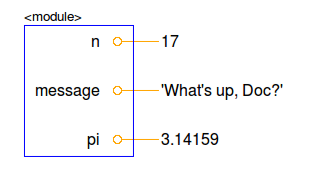
>>> bulletin = "What'due south up, Doc?" >>> n = 17 >>> pi = 3.14159 The example higher up makes three assignments. The first assigns the string value "What's upward, Dr.?" to the name bulletin . The 2d gives the integer 17 the name n , and the third assigns the floating-indicate number three.14159 the proper noun pi .
Assignment statements create names and associate these names with values. The values tin can then be retrieved from the calculator's retention past refering to the name associated with them.
>>> message "What's upwardly, Doc?" >>> pi 3.14159 >>> n 17 >>> impress ( message ) What'south up, Doctor? Names are also called variables, since the values to which they refer can change during the execution of the program. Variables likewise have types. Once again, we can enquire the interpreter what they are.
>>> type ( message ) <class 'str'> >>> type ( n ) <class 'int'> >>> type ( pi ) <class 'float'> The blazon of a variable is the type of the value information technology currently refers to.
A common fashion to stand for variables on newspaper is to write the name of the variable with a line connecting it with its electric current value. This kind of figure is called an object diagram. It shows the country of the variables at a particular instant in time.
This diagram shows the result of executing the previous consignment statements:
2.5. Variables are variable
We utilise variables in a program to "remember" things, like the current score at the football. But variables are variable. This means they can alter over time, simply like the scoreboard at a football game. You can assign a value to a variable, and later assign a different value to the same variable.
Note
This is different from math. In math, if you give ten the value 3, it cannot change to link to a dissimilar value half-fashion through your calculations!
>>> mean solar day = "Th" >>> 24-hour interval 'Thursday' >>> twenty-four hour period = "Fri" >>> mean solar day 'Friday' >>> day = 21 >>> day 21 You'll observe we changed the value of 24-hour interval three times, and on the tertiary consignment we fifty-fifty gave it a value that was of a different type.
Note
A corking bargain of programming is about having the computer recollect things, like assigning a variable to the number of missed calls on your phone, and then arranging to update the variable when you miss some other phone call.
In the Python shell, inbound a name at the prompt causes the interpreter to expect up the value associated with the name (or render an fault message if the name is non defined), and to brandish information technology. In a script, a defined name non in a impress role phone call does not display at all.
2.6. The consignment operator is non an equal sign!
The semantics of the assignment statement tin be disruptive to beginning programmers, especially since the assignment token, = can exist easily confused with the with equals (Python uses the token == for equals, as we will run into shortly). It is not!
>>> n = 17 >>> n = northward + ane >>> due north eighteen The middle statement to a higher place would be impossible if = meant equals, since n could never exist equal to northward + 1 . This statement is perfectly legal Python, still. The assignment statement links a name, on the left hand side of the operator, with a value, on the right manus side.
The two northward s in n = n + 1 have dissimilar meanings: the north on the right is a memory await-up that is replaced by a value when the right hand side is evaluated past the Python interpreter. It has to already exist or a name fault will result. The right hand side of the consignment statement is evaluated beginning.
The n on the left is the name given to the new value computed on the right hand side equally it is stored in the computer's retentivity. It does not accept to exist previously, since information technology will be added to the running program'southward available names if it isn't in that location already.
Note
Names in Python exist within a context, called a namespace, which nosotros will discuss later in the volume.
The left hand side of the assignment statement does accept to exist a valid Python variable proper noun. This is why y'all volition go an mistake if you enter:
Tip
When reading or writing code, say to yourself "northward is assigned 17" or "n gets the value 17". Don't say "n equals 17".
Annotation
In case you lot are wondering, a token is a character or string of characters that has syntactic pregnant in a language. In Python operators, keywords, literals, and white space all form tokens in the language.
ii.7. Variable names and keywords
Valid variable names in Python must conform to the following iii simple rules:
-
They are an arbitrarily long sequence of letters and digits.
-
The sequence must begin with a letter.
-
In addtion to a..z, and A..Z, the underscore (
_) is a letter.
Although it is legal to utilize uppercase letters, by convention we don't. If yous practise, call back that case matters. day and Twenty-four hours would be different variables.
The underscore character ( _ ) can appear in a name. It is often used in names with multiple words, such as my_name or price_of_tea_in_china .
At that place are some situations in which names commencement with an underscore have special pregnant, so a safe rule for beginners is to first all names with a alphabetic character other than the underscore.
If you give a variable an illegal proper noun, you get a syntax error:
>>> 76trombones = "big parade" SyntaxError: invalid syntax >>> more$ = 1000000 SyntaxError: invalid syntax >>> class = "Computer Science 101" SyntaxError: invalid syntax 76trombones is illegal because it does non begin with a letter of the alphabet. more$ is illegal because it contains an illegal character, the dollar sign. But what's wrong with class ?
Information technology turns out that class is one of the Python keywords. Keywords define the linguistic communication's syntax rules and structure, and they cannot exist used equally variable names.
Python 3 has xxx-three keywords (and every now and over again improvements to Python introduce or eliminate one or ii):
| and | as | affirm | interruption | class | keep |
| def | del | elif | else | except | finally |
| for | from | global | if | import | in |
| is | lambda | nonlocal | not | or | pass |
| heighten | return | endeavour | while | with | yield |
| True | Fake | None |
You might want to keep this list handy. Really, as will often be the case when learning to programme with Python, when y'all aren't certain about something, you can inquire Python:
>>> import keyword >>> keyword . kwlist ['Simulated', 'None', 'True', 'and', 'as', 'affirm', 'intermission', 'course', 'continue', 'def', 'del', 'elif', 'else', 'except', 'finally', 'for', 'from', 'global', 'if', 'import', 'in', 'is', 'lambda', 'nonlocal', 'non', 'or', 'pass', 'raise', 'return', 'endeavor', 'while', 'with', 'yield'] The list of keywords, keyword.kwlist , comes to us, appropriately, in a Python list.
If the interpreter complains about one of your variable names and yous don't know why, run across if it is on this list.
Programmers generally choose names for their variables that are meaningful to the human readers of the program — they aid the programmer document, or remember, what the variable is used for.
Caution
Beginners sometimes confuse meaningful to the man readers with meaningful to the reckoner. So they'll wrongly think that considering they've called some variable average or pi , it volition somehow automatically calculate an average, or automatically acquaintance the variable pi with the value three.14159. No! The calculator doesn't attach semantic meaning to your variable names. Information technology is up to you to do that.
2.8. Statements and expressions
A statement is an instruction that the Python interpreter can execute. Nosotros have seen two so far, the assignment statement and the import argument. Another kinds of statements that nosotros'll come across before long are if statements, while statements, and for statements. (At that place are other kinds too!)
When yous blazon a statement on the command line, Python executes it. The interpreter does not display any results.
An expression is a combination of values, variables, operators, and calls to functions. If you type an expression at the Python prompt, the interpreter evaluates it and displays the outcome, which is ever a value:
>>> 1 + 1 2 >>> len ( 'howdy' ) 5 In this example len is a built-in Python function that returns the number of characters in a string. We've previously seen the impress and the type functions, so this is our third instance of a function.
The evaluation of an expression produces a value, which is why expressions can announced on the correct manus side of assignment statements. A value all by itself is a simple expression, and so is a variable.
>>> 17 17 >>> y = 3.14 >>> x = len ( 'hi' ) >>> ten v >>> y iii.14 2.nine. Operators and operands
Operators are special tokens that represent computations like addition, multiplication and sectionalisation. The values the operator uses are called operands.
The post-obit are all legal Python expressions whose significant is more or less clear:
twenty + 32 hr - 1 60 minutes * sixty + infinitesimal minute / sixty 5 ** ii ( v + ix ) * ( 15 - 7 ) The tokens + and - , and the apply of parenthesis for grouping, mean in Python what they hateful in mathematics. The asterisk ( * ) is the token for multiplication, and ** is the token for exponentiation (raising a number to a power).
>>> 2 ** 3 8 >>> iii ** ii 9 When a variable proper noun appears in the place of an operand, it is replaced with its value earlier the performance is performed.
Addition, subtraction, multiplication, and exponentiation all exercise what you lot expect.
Instance: so allow us convert 645 minutes into hours:
>>> minutes = 645 >>> hours = minutes / 60 >>> hours ten.75 Oops! In Python three, the partitioning operator / always yields a floating point result. What nosotros might have wanted to know was how many whole hours there are, and how many minutes remain. Python gives u.s. two different flavors of the division operator. The second, chosen integer partition uses the token // . It always truncates its result down to the next smallest integer (to the left on the number line).
>>> 7 / 4 1.75 >>> 7 // 4 1 >>> minutes = 645 >>> hours = minutes // lx >>> hours 10 Accept intendance that yous choose the correct division operator. If you're working with expressions where y'all need floating bespeak values, use the division operator that does the segmentation appropriately.
ii.10. The modulus operator
The modulus operator works on integers (and integer expressions) and gives the residual when the get-go number is divided past the second. In Python, the modulus operator is a percent sign ( % ). The syntax is the same equally for other operators:
>>> 7 // 3 # integer division operator 2 >>> 7 % iii one And then 7 divided past three is 2 with a residue of 1.
The modulus operator turns out to be surprisingly useful. For example, you can check whether one number is divisible by another – if x % y is aught, then ten is divisible by y .
Besides, yous can extract the right-about digit or digits from a number. For example, x % x yields the right-about digit of x (in base 10). Similarly x % 100 yields the concluding two digits.
It is also extremely useful for doing conversions, say from seconds, to hours, minutes and seconds. So permit'southward write a program to enquire the user to enter some seconds, and we'll catechumen them into hours, minutes, and remaining seconds.
total_secs = int ( input ( "How many seconds, in total? " )) hours = total_secs // 3600 secs_still_remaining = total_secs % 3600 minutes = secs_still_remaining // threescore secs_finally_remaining = secs_still_remaining % 60 print ( hours , ' hrs ' , minutes , ' mins ' , secs_finally_remaining , ' secs' ) ii.eleven. Gild of operations
When more i operator appears in an expression, the order of evaluation depends on the rules of precedence. Python follows the same precedence rules for its mathematical operators that mathematics does. The acronym PEMDAS is a useful way to remember the lodge of operations:
-
Parentheses have the highest precedence and can be used to force an expression to evaluate in the gild yous want. Since expressions in parentheses are evaluated first,
2 * (3-1)is iv, and(1+ane)**(5-2)is 8. You can also use parentheses to make an expression easier to read, as in(minute * 100) / 60, even though it doesn't change the consequence. -
Exponentiation has the next highest precedence, so
2**one+1is 3 and not iv, and3*1**3is 3 and not 27. -
Gultiplication and both Division operators have the same precedence, which is higher than Addition and Subtraction, which likewise have the aforementioned precedence. So
2*3-1yields 5 rather than 4, andv-2*2is 1, non 6. #. Operators with the aforementioned precedence are evaluated from left-to-right. In algebra we say they are left-associative. So in the expressionsix-3+ii, the subtraction happens commencement, yielding 3. Nosotros and so add 2 to get the issue 5. If the operations had been evaluated from right to left, the result would have beenhalf dozen-(3+2), which is 1. (The acronym PEDMAS could mislead yous to thinking that segmentation has higher precedence than multiplication, and add-on is done ahead of subtraction - don't exist misled. Subtraction and addition are at the aforementioned precedence, and the left-to-right rule applies.)
Annotation
Due to some historical quirk, an exception to the left-to-right left-associative rule is the exponentiation operator **, so a useful hint is to always use parentheses to force exactly the order y'all want when exponentiation is involved:
>>> 2 ** iii ** ii # the right-almost ** operator gets done first! 512 >>> ( 2 ** iii ) ** 2 # use parentheses to force the order you want! 64 The immediate mode control prompt of Python is great for exploring and experimenting with expressions like this.
2.12. Operations on strings
In general, you cannot perform mathematical operations on strings, even if the strings wait similar numbers. The following are illegal (bold that bulletin has type string):
message - one "Hullo" / 123 bulletin * "Hello" "fifteen" + two Interestingly, the + operator does work with strings, but for strings, the + operator represents concatenation, non add-on. Concatenation ways joining the two operands by linking them end-to-end. For example:
fruit = "banana" baked_good = " nut bread" impress ( fruit + baked_good ) The output of this program is assistant nut bread . The space earlier the word nut is role of the string, and is necessary to produce the infinite between the concatenated strings.
The * operator also works on strings; it performs repetition. For example, 'Fun' * 3 is 'FunFunFun' . One of the operands has to exist a string; the other has to be an integer.
On one hand, this interpretation of + and * makes sense by analogy with add-on and multiplication. Just as iv * 3 is equivalent to 4 + 4 + 4 , nosotros wait "Fun" * three to be the same as "Fun" + "Fun" + "Fun" , and it is. On the other mitt, at that place is a pregnant fashion in which string concatenation and repetition are different from integer addition and multiplication. Tin you recall of a property that addition and multiplication have that string concatenation and repetition do not?
2.13. Type converter functions
Here we'll look at iii more than Python functions, int , float and str , which will (endeavor to) catechumen their arguments into types int , bladder and str respectively. We telephone call these type converter functions.
The int function tin have a floating signal number or a cord, and turn it into an int. For floating point numbers, it discards the fractional portion of the number - a process we call truncation towards zero on the number line. Let us see this in action:
>>> int(3.14) 3 >>> int(3.9999) # This doesn't round to the closest int! iii >>> int(3.0) 3 >>> int(-three.999) # Note that the result is closer to cipher -3 >>> int(minutes/60) 10 >>> int("2345") # parse a string to produce an int 2345 >>> int(17) # int fifty-fifty works if its argument is already an int 17 >>> int("23 bottles") Traceback (most recent call final): File "<interactive input>", line one, in <module> ValueError: invalid literal for int() with base 10: '23 bottles' The last example shows that a string has to be a syntactically legal number, otherwise yous'll get one of those pesky runtime errors.
The type converter float can plough an integer, a float, or a syntactically legal cord into a float.
>>> bladder ( 17 ) 17.0 >>> bladder ( "123.45" ) 123.45 The blazon converter str turns its statement into a cord:
>>> str ( 17 ) '17' >>> str ( 123.45 ) '123.45' two.14. Input
There is a built-in function in Python for getting input from the user:
name = input ( "Please enter your name: " ) The user of the plan can enter the name and press return . When this happens the text that has been entered is returned from the input function, and in this case assigned to the variable proper noun .
The string value inside the parentheses is called a prompt and contains a message which volition be displayed to the user when the argument is executed to prompt their response.
When a key is pressed on a keyboard a single character is sent to a keyboard buffer within the reckoner. When the enter key is pressed, the sequence of characters inside the keyboard buffer in the order in which they were received are returned by the input office as a single string value.
Even if you asked the user to enter their age, you would get dorsum a cord like "17" . It would be your job, as the programmer, to catechumen that string into a int or a bladder, using the int or float converter functions we saw in the previous section, which leads us to …
2.fifteen. Composition
So far, nosotros accept looked at the elements of a program — variables, expressions, statements, and role calls — in isolation, without talking about how to combine them.
One of the most useful features of programming languages is their ability to take small-scale edifice blocks and compose them into larger chunks.
For example, we know how to become the user to enter some input, we know how to convert the cord we get into a bladder, nosotros know how to write a complex expression, and we know how to print values. Let'due south put these together in a modest four-step program that asks the user to input a value for the radius of a circle, and then computes the surface area of the circle from the formula

Firstly, we'll do the four steps ane at a fourth dimension:
response = input ( "What is your radius? " ) r = float ( response ) expanse = three.14159 * r ** 2 impress ( "The area is " , area ) Now let'southward compose the get-go two lines into a unmarried line of lawmaking, and compose the second ii lines into some other line of code.
r = float ( input ( "What is your radius? " )) impress ( "The area is " , 3.14159 * r ** 2 ) If we really wanted to be tricky, nosotros could write it all in ane statement:
print ( "The surface area is " , 3.14159 * float ( input ( "What is your radius? " )) ** ii ) Such compact code may not be almost understandable for humans, simply it does illustrate how we can compose bigger chunks from our building blocks.
If you're ever in doubtfulness about whether to etch lawmaking or fragment it into smaller steps, try to arrive as simple equally y'all can for the homo reader to follow.
two.16. More near the print office
At the cease of the previous chapter, you learned that the print function tin can accept a series of arguments, seperated by commas, and that it prints a cord with each statement in gild seperated by a space.
In the instance in the previous section of this chapter, you may take noticed that the arguments don't have to be strings.
>>> impress ( "I am" , 12 + 9 , "years one-time." ) I am 21 years old. >>> By default, impress uses a single space as a seperator and a \n as a terminator (at the end of the string). Both of these defaults tin be overridden.
>>> print ( 'a' , 'b' , 'c' , 'd' ) a b c d >>> impress ( 'a' , 'b' , 'c' , 'd' , sep = '##' , finish = '!!' ) a##b##c##d!!>>> Yous volition explore these new features of the print office in the exercises.
ii.17. Glossary
- assignment statement
-
A statement that assigns a value to a name (variable). To the left of the assignment operator,
=, is a proper noun. To the right of the assignment token is an expression which is evaluated by the Python interpreter and so assigned to the proper name. The difference between the left and right paw sides of the assignment argument is oftentimes confusing to new programmers. In the following assignment:nplays a very different part on each side of the=. On the right it is a value and makes up office of the expression which volition be evaluated by the Python interpreter before assigning information technology to the name on the left. - assignment token
-
=is Python's assignment token, which should not exist confused with the mathematical comparison operator using the aforementioned symbol. - composition
-
The ability to combine simple expressions and statements into chemical compound statements and expressions in order to represent complex computations concisely.
- concatenate
-
To bring together two strings end-to-end.
- data type
-
A prepare of values. The type of a value determines how it can be used in expressions. So far, the types you have seen are integers (
int), floating-betoken numbers (bladder), and strings (str). - escape sequence
-
A sequence of characters starting with the escape character (
\) used to stand for cord literals such as linefeeds and tabs. - evaluate
-
To simplify an expression by performing the operations in order to yield a single value.
- expression
-
A combination of variables, operators, and values that represents a unmarried upshot value.
- float
-
A Python information type which stores floating-point numbers. Floating-point numbers are stored internally in two parts: a base and an exponent. When printed in the standard format, they look like decimal numbers. Beware of rounding errors when you utilise
floats, and remember that they are only guess values. - int
-
A Python information type that holds positive and negative whole numbers.
- integer division
-
An performance that divides one integer by another and yields an integer. Integer division yields only the whole number of times that the numerator is divisible by the denominator and discards any balance.
- keyword
-
A reserved word that is used past the compiler to parse program; you lot cannot use keywords like
if,def, andwhileevery bit variable names. - literal
-
A note for representing for representing a constant value of one of Python'due south congenital-in types.
\n, for instance, is a literal representing the newline graphic symbol. - modulus operator
-
An operator, denoted with a pct sign (
%), that works on integers and yields the residue when one number is divided by some other. - object diagram
-
A graphical representation of a set of variables (objects) and the values to which they refer, taken at a item instant during the plan'southward execution.
- operand
-
Ane of the values on which an operator operates.
- operator
-
A special symbol that represents a uncomplicated computation like addition, multiplication, or string concatenation.
- rules of precedence
-
The set of rules governing the order in which expressions involving multiple operators and operands are evaluated.
- argument
-
An instruction that the Python interpreter can execute. And so far we have only seen the consignment statement, but we will presently meet the
importstatement and theforargument. - str
-
A Python data blazon that holds a string of characters.
- tripple quoted strings
-
A string enclosed by either
"""or'''. Tripple quoted strings can span several lines. - value
-
A number, string, or any of the other things that tin be stored in a variable or computed in an expression.
- variable
-
A name that refers to a value.
- variable name
-
A name given to a variable. Variable names in Python consist of a sequence of letters (a..z, A..Z, and _) and digits (0..ix) that begins with a letter of the alphabet. In all-time programming practice, variable names should be called and so that they draw their utilize in the program, making the program self documenting.
A ____ Input Is the Statement That Reads the First Input Value in a Program.
Source: https://www.openbookproject.net/books/bpp4awd/ch02.html
0 Response to "A ____ Input Is the Statement That Reads the First Input Value in a Program."
Post a Comment